Wild Huckleberry Jam
Four cups of berries, one very good jar
- Preserves & Condiments
- Preserve
- American (Rocky Mountain)
- foraging
- small batch
- gift
Wild huckleberries or blueberries cooked down with lemon and a touch of cinnamon into a dark, intensely flavoured jam. A small batch that rewards careful skimming and patient simmering.
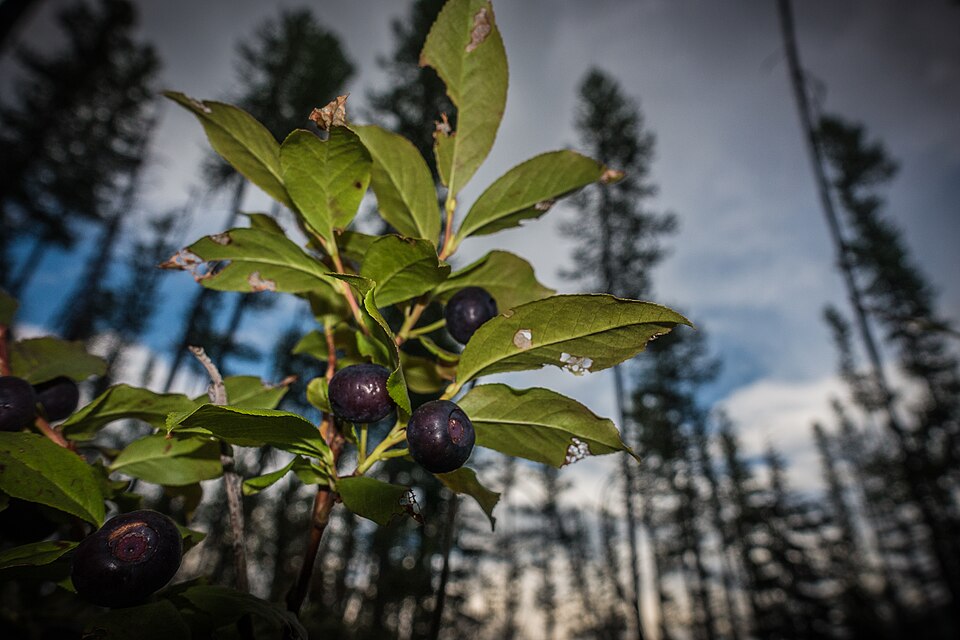
Photo: GlacierNPS · Public domain · via Wikimedia Commons · all image credits
Ingredients
- 2 pounds (900 g) wild huckleberries or blueberries, fresh or frozen
- 2 1/2 cups granulated sugar, more or less to taste
- 3 tablespoons fresh lemon juice
- 1/2 teaspoon kosher salt
- 1/4 teaspoon ground cinnamon
- 1/4 teaspoon freshly grated nutmeg
- 1 tablespoon powdered pectin, if berries are fully ripe
- 1/2 teaspoon unsalted butter, to reduce foaming
Equipment
- Wide heavy saucepan or preserving pan
- Wooden spoon
- Fine-mesh skimmer
- 4 half-pint jars with new lids
- Large canning pot and jar lifter
Why this recipe works
Huckleberries, the wild berries of the northern Rockies and Pacific Northwest, are almost impossible to cultivate and worth every minute spent on a hillside picking them. They are smaller and tarter than blueberries, with a wine-like depth that survives cooking beautifully.
If you pick more berries than you can use, freeze them on a tray and bag them; frozen berries make just as good a jam, and freezing actually helps the skins burst during cooking. This recipe scales linearly, so use whatever weight you have and adjust the sugar.
Heirloom varieties to look for
Wild huckleberry species include Vaccinium membranaceum (thin-leaf) and V. deliciosum (Cascade). If you cannot forage, use cultivated blueberries with an extra tablespoon of lemon juice, or grow a reliable garden stand-in such as Patriot or Northland blueberry.
Method
Sort and clean
Pick over the berries, removing leaves, stems and any that are bruised or green. Rinse briefly and drain well; do not soak them, which dilutes the flavour.
Combine and macerate
In the preserving pan, mash about a quarter of the berries with the wooden spoon and stir in the sugar, lemon juice, salt, cinnamon and nutmeg. Let the mixture stand for 30 minutes, stirring twice, so the sugar dissolves and draws out the juice.
Bring to a boil
Set the pan over medium-high heat and bring to a hard boil, stirring constantly with the wooden spoon to keep the sugar from catching. Add the butter, which suppresses the foam.
Skim and simmer
Skim off the foam that rises with the fine-mesh skimmer and discard it. Reduce the heat and boil steadily, stirring every couple of minutes, for 20 to 25 minutes, until the jam has reduced by roughly a third and looks glossy.
Test the set
Chill a small plate in the freezer. Drop a teaspoon of jam onto the cold plate and push it with a finger; a wrinkle means it will set firm. If it stays liquid, boil 5 more minutes and retest.
Fill the jars
Ladle the hot jam into hot, clean half-pint jars, leaving 1/4 inch of headspace. Wipe rims with a damp cloth, put on the lids and bands, and finger-tighten.
Process and rest
Lower the jars into a boiling water bath with at least 1 inch of water covering them and process for 10 minutes. Turn off the heat, let them sit 5 minutes in the water, then lift out and cool undisturbed for 12 hours.
Cook's notes
- Stir a little constantly and scrape the bottom of the pan; the high sugar content means the jam scorches in seconds.
- Never double the batch in one pot. Large volumes boil unevenly and often fail to set.
- If the jam sets too firmly, warm the jar in a bowl of hot water before serving to loosen it.
Variations
- Add 1 tablespoon of grated orange zest and 2 tablespoons of Grand Marnier in the last 2 minutes of cooking.
- Swap the cinnamon for 1/2 teaspoon of ground cardamom for a brighter, more floral preserve.
- Add 1 cup of finely diced apple, which contributes pectin and gives a soft, spoonable set.
Storage
Processed jars keep for up to 12 months in a cool, dark cupboard. Once opened, refrigerate and use within 3 weeks. Freezer jam made with half the sugar keeps for 6 months frozen.
How to serve it
About 1 tablespoon per serving. Serve it within the time noted above for the best texture, because heirloom produce is far less forgiving than supermarket vegetables.